Bad Apple.

bad-apples“And to the angel of the church in Pergamos write, `These things says He who has the sharp two-edged sword:  “I know your works, and where you dwell, where Satan’s throne is. And you hold fast to My name, and did not deny My faith even in the days in which Antipas was My faithful martyr, who was killed among you, where Satan dwells. “But I have a few things against you, because you have there those who hold the doctrine of Balaam, who taught Balak to put a stumbling-block before the children of Israel, to eat things sacrificed to idols, and to commit sexual immorality. “Thus you also have those who hold the doctrine of the Nicolaitans, which thing I hate. `Repent, or else I will come to you quickly and will fight against them with the sword of My mouth. (Rev 2:12-16 NKJ)

Pergamum, John’s third church. Pergamum was like going to the store to buy apples and being sold a bag of apples that was half good and half rotten.  The good was really good, faithful and true, even to the point of death.  The bad though was really bad, God asks them, “But why do you indulge that Balaam crowd? Don’t you remember that Balaam was an enemy agent, seducing Balak and sabotaging Israel’s holy pilgrimage by throwing unholy parties? And why do you put up with the Nicolaitans, who do the same thing?” As a Christian, you can’t be partially holy or partially sanctified.  Doing that which is wrong nullifies the good.

Deal with it and remove the bad or the Word will stand against you, and the Sword of the Spirit, that double-edged sword will cut, and cut deep. Strong words to this church and to us.

Posted in Uncategorized | Leave a comment

The Smyrna Fellowship–faithful to the end.

“I know your works, tribulation, and poverty (but you are rich); and I know the blasphemy of those whosmynar say they are Jews and are not, but are a synagogue of Satan.  “Do not fear any of those things which you are about to suffer. Indeed, the devil is about to throw some of you into prison, that you may be tested, and you will have tribulation ten days. Be faithful until death, and I will give you the crown of life. “He who has an ear, let him hear what the Spirit says to the churches. He who overcomes shall not be hurt by the second death.”‘ (Rev 2:9-11 NKJ)

So why do bad things happen to good people? If you were a member of the Smyrna congregation, that just might be a question you would ask. Jesus gives a message to this church, “I know your affliction and distress and pressing trouble and your poverty—but you are rich!” Their suffering, poverty, and persecutions were merciless, but because they loved the things the Lord loved and loved the Lord they were rich.  Riches that may never find on earth, but they were waiting for them in eternity. Slandered by the Jews and as elsewhere, so at Smyrna they bitterly opposed Christianity; and at Polycarp’s martyrdom they joined the heathens in clamoring for his being cast to the lions; and when there was an obstacle to this, for his being burnt alive; and with their own hands they carried logs for the pile.

Hold fast and be faithful, some will be thrown in prison and death will soon follow.  The good news is that Jesus has already defeated death, Hell, and the grave, you get to wear the Victors crown.  In the meantime listen to the Spirit, he will lead you and guide you.

The slanderer and the accuser may have a first word but we have the last laugh!

Posted in Uncategorized | Leave a comment

John’s Church at Ephesus.

ephesus[Just a point of clarification—Dispensationalists or Dispensational Theology is a religious interpretation of the Bible. It considers Biblical history as divided deliberately by God into defined periods. God judges’ humanity at the end of one period and introduces a new a new one. So the seven churches in Revelation are seen as seven dispensations of time and The Book of Revelation as periods of prophetic. Needless to say, I am not a Dispensationalist.]

“To the angel of the church of Ephesus write, `These things says He who holds the seven stars in His right hand, who walks in the midst of the seven golden lampstands: “I know your works, your labor, your patience, and that you cannot bear those who are evil. And you have tested those who say they are apostles and are not, and have found them liars; “and you have persevered and have patience, and have labored for My name’s sake and have not become weary. “Nevertheless I have this against you, that you have left your first love. “Remember therefore from where you have fallen; repent and do the first works, or else I will come to you quickly and remove your lampstand from its place– unless you repent. “But this you have, that you hate the deeds of the Nicolaitans, which I also hate. “He who has an ear, let him hear what the Spirit says to the churches. To him who overcomes, I will give to eat from the tree of life, which is in the midst of the Paradise of God.”‘ (Rev 2:1-7 NKJ)

All the churches face a persecution and for one or two that level of persecution is intense. John recognizes their suffering and acknowledges the fact that the Roman system, code word Babylon, is corrupt and very wicked. He encourages them with the revelation of Christ as the Lamb of God and the one who wins the battle and makes everything right in the end. In the meantime, though, John calls the churches to some self-reflection.
The source of light in a lighthouse is the bulb. The lenses around the outside of the magnify the light. Jesus is the light, and the church should be the lens, magnifying the light for all to see. The church at Ephesus was hard working and knew its doctrines and dogmas. They were so hot on being right that nobody was good enough, or even wanted to join. They had lost their desire to shine bright and grow as a community. The danger was that the light could go out.

God’s word to them was simple:
1. Repent and regain your first love—hurry!
2. Listen to what the Spirit is saying.
3. Keep your eyes on the prize—the victory banquet.
We can become so program busy that we forget why we’re here—time to refocus.

Posted in Uncategorized | Leave a comment

666?

neros-circusHe causes all, both small and great, rich and poor, free and slave, to receive a mark on their right hand or on their foreheads, and that no one may buy or sell except one who has the mark or the name of the beast, or the number of his name. Here is wisdom. Let him who has understanding calculate the number of the beast, for it is the number of a man: His number is 666.  (Rev 13:16-14:1 NKJ)

Governments throughout the centuries have used various code systems to send and receive classified, secret messages that they didn’t want to fall into the hands of the enemy. Today encryption is used whereby only those with the code can read certain messages. 

John is writing to seven first-century churches in what is modern day Turkey. The ruling government is oppressive and anti-Christian, and the antics of Emporer Nero make ISIS seem like pussycats.  The modern day Basilicas of St. Peter is built on the site of Nero’s Circus where the citizens of Rom would come to be entertained. There you would find chariot races, Gladiator fights, and the killing of Christians by throwing in with wild animals or dipping them in oil, tying them to a stake and setting them on fire. His hatred for Christians increases after the great fire of Rome in AD 64. Nero was regarded as a beast and when he finally committed suicide, somewhere happy, some sad and a large majority scared that he would come back.  So strong was this belief that even Augustine of Hippo wrote about it in AD 422. Three imposters, claiming to be a reincarnation of Nero, tried to lead rebellions.

The beast with seven heads and the number 666 seem to allude directly to emperor Nero (reigned AD 54-68). Though John didn’t write Revelation in the 60’s, the impression Nero made and the story of his return made a huge impression.  The Emperor of the day, Domitian, was also a persecutor of the church.  

But what about all this so called Bible prophecy? The Revelation of Jesus Christ was never intended to be a  prophetic book, and though it does contain some Messianic hope for the future, John merely wanted to encourage the Christians of his day.  In short, the dispensational teaching of Revelations is a pack of lies.

Going Deeper…

In both ancient Greek and Hebrew, letters also represented numerals (as they do in Latin), their values assigned according to the order of the alphabet, alpha, and aelph, for example, having the numerical value of 1. By adding these values, words could be represented as the sum of their numbers. This literation of numbers and numeration of letters was known as isopsephism by the Greeks and gematria by the Jews (which, in cabalistic practice, has been used to interpret Hebrew scripture). If the Greek letters of Nero Caesar (Neron Kaisar) are transliterated into Hebrew (nrwn qsr), the numerical of these Hebrew letters equals 666. One should appreciate, by the way, that there were no numbers in Greek or Hebrew and that the “the number of the beast” was not presented as a figure but as letters of the alphabet or written in full. That is to say; it was not expressed as “666” (indeed, discrete Arabic numerals would not be invented for another five hundred years) but as the numerical values of the three letters representing 600, 60, and 6.

http://penelope.uchicago.edu/~grout/encyclopaedia_romana/gladiators/nero.html


Posted in Uncategorized | Leave a comment

Going Deeper–Afterlife for Jews and Muslims

jewish-afterlifeJews believe that at the point of death the soul will blame the body for its actions. Judgement will take place after the coming of the Messiah. Although many Jews believe that they will be punished or rewarded after death for the way in which they have lived their lives, there is no clear teaching about heaven. For the Jew the soul goes to a place of rest.

Islam teaches that Muslims have both a physical body and a soul. The soul lives on after death and waits to be judged. Akhirah is the Muslim term used for life after death. Muslims believe that, on the Day of Judgement, they will be judged for their actions in life.

islam-afterlifeAfterlife: Day of Judgment, Heaven, Hell. Muslims believe that after facing the Judgment of Allah (God), people will be either admitted to Heaven by His mercy, or entered into Hell by His justice.

Posted in Uncategorized | Leave a comment

What Does the Apostle Paul Mean by the Word ‘Sleep?’

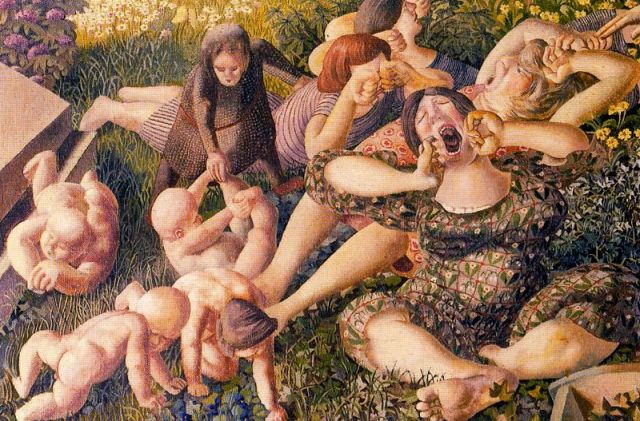
the-resurrection-waking-up-1945

Stanley Spencer — Waking Up!

Behold, I tell you a mystery: We shall not all sleep, but we shall all be changed–in a moment, in the twinkling of an eye, at the last trumpet. For the trumpet will sound, and the dead will be raised incorruptible, and we shall be changed. For this corruptible must put on incorruption, and this mortal must put on immortality. So when this corruptible has put on incorruption, and this mortal has put on immortality, then shall be brought to pass the saying that is written: “Death is swallowed up in victory.” “O Death, where is your sting? O Hades, where is your victory?” The sting of death is sin, and the strength of sin is the law. But thanks be to God, who gives us the victory through our Lord Jesus Christ.  (1Co 15:51-57 NKJ)


For if we believe that Jesus died and rose again, even so God will bring with Him those who sleep in Jesus. For this we say to you by the word of the Lord, that we who are alive and remain until the coming of the Lord will by no means precede those who are asleep. For the Lord Himself will descend from heaven with a shout, with the voice of an archangel, and with the trumpet of God. And the dead in Christ will rise first. Then we who are alive and remain shall be caught up together with them in the clouds to meet the Lord in the air. And thus we shall always be with the Lord. Therefore comfort one another with these words. (1Th 4:14-18 NKJ)

For if the dead do not rise, then Christ is not risen. And if Christ is not risen, your faith is futile; you are still in your sins! Then also those who have fallen asleep in Christ have perished. If in this life only we have hope in Christ, we are of all men the most pitiable. But now Christ is risen from the dead and has become the firstfruits of those who have fallen asleep. (1Co 15:16-20 NKJ

So when you die what happens? Well, your body goes into the grave, either literally (burial) or figuratively (cremation or accidental death where no body is found, for instance, 9/11), to await the resurrection. Paul tells us that, “To be absent from the body and to be present with the Lord. (2Co 5:8 NKJ) At the resurrection, if we have gone on to be with the Lord we shall return with him and exchange the corruptible for incorruption.  In other words, we will get a new physical body.

So why does Paul confuse people by using the term ‘sleep.’ For instance, Paul uses the word in both 1 Thessalonians and in 1 Corinthians either as sleep or asleep.  The word is used figuratively of death, so after Jesus’ death and resurrection what does the word sleep mean for the Christian?

Four quick points from the Bible Dictionary that might clarify any confusion:

1.      Jesus is never said to have fallen asleep. He died on that cross, went into the grave and rose again, having defeated death, hell, and the grave.

2.      Believers are said to fall asleep at death ( 1 Corinthians 15:6 1 Corinthians 15:18 1 Corinthians 15:20 ; 1 Thessalonians 4:13 1 Thessalonians 4:15 ), and in one instance “to fall asleep in Jesus” ( 1 Thess 4:14 ). Although believers are still occasionally said to die, death is described as gain ( Php 1:21 ); it has lost its sting ( 1 Cor 15:54-57 ). Death comes attended by blessedness and rest ( Rev 14:13 ) and a conscious sense of the presence of Christ ( 2 Cor 5:8 ). Death is, in fact, not death anymore, and those who believe in Jesus will never really die, even though they might still experience what used to be called death ( John 11:25-26 ). So the metaphor of sleep is used to emphasize that we have no more to fear from death than we do from falling asleep.

3.      Believers are never said to have fallen asleep in the death of Jesus; rather, we died with him ( Col 2:20 ; 2 Tim 2:11 ) or were crucified with him ( Gal 2:20 ). It is only because of Jesus’ death, and our death in him that death no longer holds any terror instead becoming a peaceful sleep and a blessedness ( Rev 14:13 ).

4.      Not only do believers never experience death (in the old way) anymore, although they must go through what is metaphorically called sleep; there are some who will not even suffer death. There will be a generation alive at the second coming of Christ ( 1 Cor 15:51 ), they will not sleep, but will be transformed instantaneously into their new unending life. (1 Thes 4:14-18)

Hope you’ll forgive me for taking rather longer today, but I hope you will agree with me that the clarification was worthwhile.

Dictionaries – Baker’s Evangelical Dictionary of Biblical Theology

Posted in Uncategorized | Leave a comment

No Rapture, just Resurrection!

For if we believe that Jesus died and rose again, even so God will bring with Him those who sleep in Jesus. For this we say to you by the word of the Lord, that we who are alive and remain until the coming of the Lord will by no means precede those who are asleep. For the Lord Himself will descend from heaven with a shout, with the voice of an archangel, and with the trumpet of God. And the dead in Christ will rise first. Then we who are alive and remain shall be caught up together with them in the clouds to meet the Lord in the air. And thus we shall always be with the Lord. Therefore comfort one another with these words. (1Th 4:14-18 NKJ)

Behold, I tell you a mystery: We shall not all sleep, but we shall all be changed–in a moment, in the twinkling of an eye, at the last trumpet. For the trumpet will sound, and the dead will be raised incorruptible, and we shall be changed. For this corruptible must put on incorruption, and this mortal must put on immortality. So when this corruptible has put on incorruption, and this mortal has put on immortality, then shall be brought to pass the saying that is written: “Death is swallowed up in victory.” “O Death, where is your sting? O Hades, where is your victory?” The sting of death is sin, and the strength of sin is the law. But thanks be to God, who gives us the victory through our Lord Jesus Christ.  (1Co 15:51-57 NKJ)

Stay with me in this text, let scripture not tradition speak for itself.  Paul’s key thought here is the resurrection.  Quite a few Christians in Paul’s time believed that Jesus was going to return immediately.  When that didn’t happen, they started to wonder as to what would happen. The picture here in the Greek is one of a king returning from war, with trumpets blasting, the shout of the archangel,  Jesus comes with all those souls that had died before his return. Their old bodies that were buried in corruption will be exchanged for immortality.  We who are still alive, as Paul tells us in 1 Corinthians, will be changed in a moment, we will get new bodies.  These new bodies will probably be able to do amazing things since they are not weighed down by sin. A keyword in the text is the word ‘coming—Parousia*.’ As soon as Paul mentioned this, his audience of his day would have associated Jesus’ return with the return of a Caesar.  People being excited would run out to meet him and in a procession, leading him back into the city. So with our new bodies, we meet Jesus in the air and bring him back into the city, possibly the new Jerusalem of Revelation 21.

No rapture, just resurrection—Hallelujah! Rapture was the invention of John Darby, 1830 and later in the Scofield Bible.  Whenever we have an eschatology based on fear we have a problem because as John tells us, “There is no fear in love; but perfect love casts out fear because fear involves torment. But he who fears has not been made perfect in love.” (1Jo 4:18 NKJ)

Posted in Uncategorized | Leave a comment

Community is central in Jewish Eschatology.

fesq445980I tell the truth in Christ, I am not lying, my conscience also bearing me witness in the Holy Spirit, that I have great sorrow and continual grief in my heart. For I could wish that I myself were accursed from Christ for my brethren, my countrymen according to the flesh, who are Israelites, to whom pertain the adoption, the glory, the covenants, the giving of the law, the service of God, and the promises; of whom are the fathers and from whom, according to the flesh, Christ came, who is over all, the eternally blessed God. Amen. (Rom 9:1-5 NKJ)

The Pharisees really do get a bad rap.  They were passionate about the resurrection and actually had a strong eschatology, belief that in the ‘last days’ messiah would come and God would establish his peaceable kingdom.  The Septuagint, the Greek translation of the Old Testament, has several books that were later decided not to be canonical, one of these books is called the Psalms of Solomon.  One of the psalms talks about ‘longing after God.’ Psalm 42:1 from the Septuagint says, “As the hart earnestly desires the fountains of water, so my soul earnestly longs for thee, O God.” (Psa 42:1 LXE).

The Christian’s first instinct is to interpret this from an individual standpoint, but the Jew and Paul for that matter regarded the coming Messianic Kingdom to be a community event. They wanted everyone to share the good news.  It’s no wonder that we see the church as a community in Acts 2:42-44.

For Paul, “we have many members in one body, but all the members do not have the same function, so we, being many, are one body in Christ, and individually members of one another. (Rom 12:4-5 NKJ)

Posted in Uncategorized | Leave a comment

Parousia

ceaserGoing Deeper…

For this, we say to you by the word of the Lord, that we who are alive and remain until the coming of the Lord will by no means precede those who are asleep. For the Lord Himself will descend from heaven with a shout, with the voice of an archangel, and with the trumpet of God. And the dead in Christ will rise first. Then we who are alive and remain shall be caught up together with them in the clouds to meet the Lord in the air. And thus we shall always be with the Lord.  Therefore comfort one another with these words. (1Th 4:15-18 NKJ)

Paul was not only a Jew but a Roman citizen.  As we saw in our study of Acts 17 when Paul was speaking in Athens, he was well versed in scripture, philosophy and the nuances of Greek and Roman culture. From the Ptolemaic period (an era just after the death of Alexander the Great) to the second century of the common era “parousia’ (translated in 1 Thes 4:15 as ‘coming.’) was used as an expression to denote the arrival or visit of a king or emperor, and celebrated the glory of the sovereign publicly. People would rush out to meet the emperor and escort him back into the city. In memory of the visit of Emperor Nero to the cities of Patras and Corinth, advent coins were struck that carried the legend Adventus Augusti Corinth.

Paul’s thinking then would not have been the common interpretation of today, with Derby’s ‘Rapture’ teaching, but the thought of the King’s coming and the people being caught up in excitement at the coming of the King of Kings.

Posted in Uncategorized | Leave a comment

Jewish Eschatology

isa 2He shall judge between the nations, And rebuke many people; They shall beat their swords into plowshares, And their spears into pruning hooks; Nation shall not lift up sword against nation, Neither shall they learn war any more. (Isa 2:4 NKJ)

“The wolf also shall dwell with the lamb, The leopard shall lie down with the young goat, The calf and the young lion and the fatling together; And a little child shall lead them. The cow and the bear shall graze; Their young ones shall lie down together; And the lion shall eat straw like the ox. The nursing child shall play by the cobra’s hole, And the weaned child shall put his hand in the viper’s den. They shall not hurt nor destroy in all My holy mountain, For the earth shall be full of the knowledge of the LORD As the waters cover the sea. (Isa 11:6-9 NKJ)

The Bible doesn’t disagree with itself.  The Old Testament has certain passages of Jewish eschatology that Jews all through the ages would have been looking for. According to Jewish tradition, the Messianic Era will be one of global peace and harmony, an era free of conflict and hardship, and one in which people will grow in their knowledge of Yahweh.

Paul’s teaching to the Church was going to be based on the theology of his Jewish roots, nothing different.  As a Jew, he saw Jesus as a partial fulfillment of his Jewish eschatology and the remainder was still to come.

Posted in Uncategorized | Leave a comment